












Lynparza for the treatment of prostate cancer is co-marketed by AstraZeneca (UK) and Merck Sharp & Dohme (UK)
© Copyright 2025. AstraZeneca Ltd
This is a non-promotional website developed and funded by AstraZeneca and it is intended for UK patients, or their carers, who have been prescribed an AstraZeneca medicine. This website is not intended to replace the discussions between you and your healthcare professional and it is not a substitute for the Patient Information Leaflet which is provided with your medicine.
Please select the option below which applies to you.

If you are a UK patient, or their carer, prescribed an AstraZeneca medicine, please enter myAZmed using the button below.

Discover disease education and resources for some of the conditions relevant to AstraZeneca’s work, using the button below.
If you are a UK healthcare professional looking for further information, you can visit our AZ UK Medical Information website.
If none of the above options apply, this website is not appropriate for you. To learn more about AstraZeneca as a company you can visit astrazeneca.co.uk.
This website is intended for UK patients, or their carers, who have been prescribed an AstraZeneca medicine. If this is not you, please go to https://www.astrazeneca.co.uk/

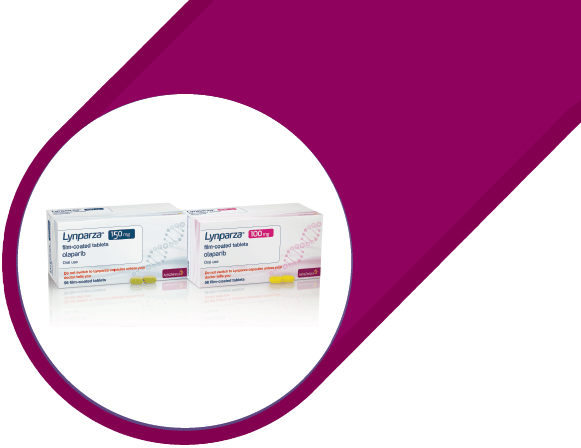
Lynparza is a tablet used to treat a type of prostate cancer called metastatic (met-uh-stat-ik) castration-resistant prostate cancer.
Metastatic means the cancer has spread beyond the original cancer in your prostate. Castration-resistant means your cancer no longer responds to treatments that lower testosterone.
You may be prescribed Lynparza on its own (monotherapy) for a specific type of prostate cancer, called BRCA-mutated metastatic castration-resistant prostate cancer. To receive Lynparza monotherapy, you will have already received an androgen receptor targeted agent (ARTA), such as enzalutamide or abiraterone, earlier in your treatment journey.
You may also be prescribed Lynparza in combination with another anti-cancer medicine called abiraterone, together with prednisone or prednisolone (a steroid), to treat metastatic castration-resistant prostate cancer.
Lynparza contains the active ingredient olaparib (ola-pa-rib). Olaparib is a type of cancer medicine called a PARP inhibitor.
PARP (poly-[adenosine diphosphate-ribose] polymerase) is a protein (enzyme) in the body that helps damaged cells repair themselves. Olaparib can block (inhibit) PARP from repairing damage in cancer cells. Without PARP, cancer cells may become too damaged to survive, and die.
This is how Lynparza can help to stop or slow down the growth of prostate cancer.
When Lynparza is used in combination with abiraterone (an androgen receptor signalling inhibitor), the combination may help enhance anti-cancer effects in prostate cancer cells.
Approval ID: GB-64869 Date of preparation: June 2025
Read the Lynparza Patient Information Leaflet before you start this treatment. It contains important information for you.
Before you start taking Lynparza:
(Select the link to learn more about each of the following)
Contraception and Sperm Donation
Monitoring Your Treatment
Your doctor will perform blood tests to check your blood cell counts:
If your blood count falls to a low level, you may need to have a blood transfusion (where you are given new blood or blood-based products from a donor).
Foods to Avoid
Do not eat grapefruit or drink grapefruit juice while you are being treated with Lynparza as it can affect the way the medicine works.
If you have any further questions on the use of this medicine, talk to your doctor, pharmacist or nurse.
Tell your doctor if you have, or have had, any other medical conditions before you start Lynparza.
Warnings and Precautions
Talk to your doctor, pharmacist or nurse before or during treatment with Lynparza if you have:
Other Medicines and Lynparza
Tell your doctor, pharmacist or nurse if you are taking, have recently taken or might take any other medicines before you start Lynparza, including medicines obtained without a prescription and herbal medicines. This is important as Lynparza can affect the way some other medicines work and vice versa.
You will find a list of medicines that may affect the way Lynparza works in the Patient Information Leaflet. Please note, the medicines listed in the Patient Information Leaflet may not be the only ones that could affect Lynparza.
Side effects occur with all medicines, especially with cancer treatments. However, not everyone will get the same symptoms, and each person will have varying symptoms at different points throughout their disease.
Listed below are possible side effects you need to be aware of when taking Lynparza. You will find a full list of potential side effects in the Patient Information Leaflet.
If you experience any side effects, talk to your doctor, pharmacist or nurse. This includes side effects not listed below.
Tell your doctor straight away if you notice any of the following
Very common side effects
These may happen to more than 1 in 10 people taking Lynparza:
These may be caused by a drop in your red blood cells (anaemia – a-nee-mia).
Other very common side effects
These may happen to more than 1 in 10 people taking Lynparza:
* Side effects that may show up in a blood test.
Common side effects
These may happen in up to 1 in 10 people taking Lynparza:
* Side effects that may show up in a blood test.
Uncommon side effects
These may happen in up to 1 in 100 people taking Lynparza:
* Side effects that may show up in a blood test.
Rare side effects
These may happen in up to 1 in 1000 people taking Lynparza:
Not a comprehensive list. Please refer to the PIL for full information.
If you notice any side effects not listed, please contact your doctor, pharmacist or nurse straight away.
Approval ID: GB-64851 Date of preparation: June 2025
Lynparza is only available on prescription. Always take this medicine exactly as your doctor, pharmacist or nurse has told you.
Follow all directions on your prescription label and read the Patient Information Leaflet. If there is anything you are not sure about, check with your doctor, pharmacist or nurse.
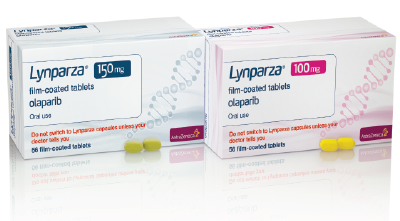
Lynparza tablets come in 2 strengths: 100 mg and 150 mg.
The recommended dose is usually 2 x 150 mg tablets, taken twice a day (a total of 4 tablets each day). Your doctor may give you a different dose if:
Please take your tablets exactly as your doctor tells you, for as long as they tell you to.

Lynparza 100 mg tablets are yellow to dark yellow, oval, bi-convex, film-coated tablets, marked with “OP100” on one side and plain on the other.
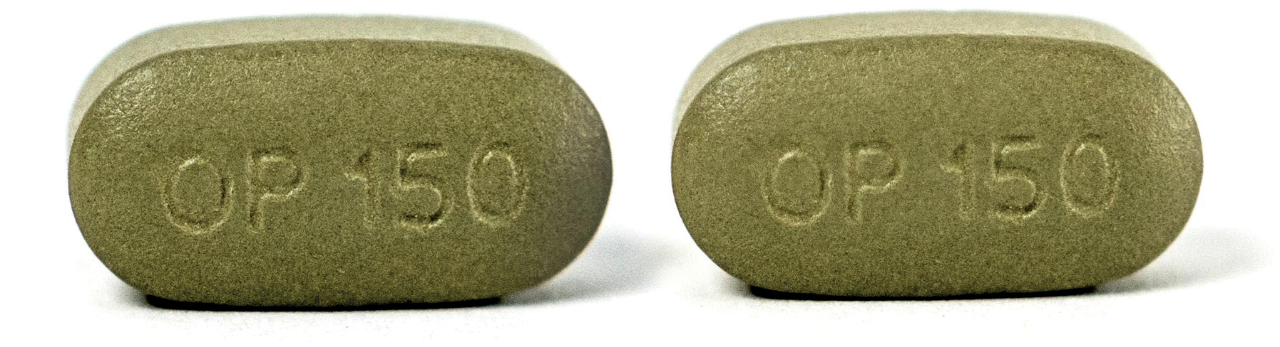
Lynparza 150 mg tablets are green to green/grey, oval, bi-convex, film-coated tablets, marked with “OP150” on one side and plain on the other.
Lynparza is supplied in packs containing 56 tablets (7 blisters of 8 tablets each), or multipacks containing 112 (2 packs of 56) film-coated tablets.
Always take this medicine exactly as your doctor, pharmacist or nurse has told you. Check with your doctor, pharmacist or nurse if you are not sure.
If you are also receiving hormonal therapies, continue taking this treatment alongside Lynparza unless advised otherwise by your doctor.
This medicine has been prescribed for you only. Do not pass it on to others. It may harm them, even if their signs of illness are the same as yours.
What if I take too much or miss a dose?
If you take more Lynparza tablets than you should, talk to a doctor or go to the nearest hospital straight away.
If you forget to take a tablet, take your next dose as planned. Do not take any extra tablets to make up for a missed dose.
Do not stop taking Lynparza without talking to your doctor first.
If you have any questions about the use of this medicine, talk to your doctor, pharmacist or nurse.
Lynparza does not need to be stored at a specific temperature, but make sure it is kept out of the sight and reach of children.
Please keep your Lynparza tablets in the packaging that you received them in to protect them from moisture.
Do not use Lynparza after the expiry date. You can find this on the blister or carton after ‘EXP’. The expiry date refers to the last day of that month.
Do not dispose of your Lynparza tablets in wastewater or household waste. Please ask your pharmacist how to dispose of Lynparza properly to help protect the environment.
Approval ID: GB-64868 Date of preparation: June 2025
If you forget to take your tablets at the planned time, take your next dose as planned at its usual time but do not take any extra tablets to make up for a missed dose. You may find it useful to use a calendar or schedule alerts to remind you to take your tablets.
If you take more Lynparza than your normal dose, contact your doctor or go to the hospital immediately. Please only take the dose prescribed to you by your doctor.
You should tell your doctor, pharmacist or nurse about any other medicines/ supplements you are taking or plan to take before you start taking Lynparza. This includes medicines you have been given by a doctor or bought yourself, such as herbal medicines.
Lynparza can affect the way some other medicines work. Also, some other medicines can affect the way Lynparza works. Please read Section 2 "Other medicines and Lynparza" in the Patient Information Leaflet for more information.
You should not eat grapefruit or drink grapefruit juice while on this treatment as it can affect the way the Lynparza works.
If you are having sex, you should use a condom and your female partner should also use a suitable method of contraception while taking this medicine and for 3 months after taking the last dose. It is not known whether Lynparza passes into semen.
You must not donate sperm while taking Lynparza and for 3 months after taking the last dose.
Lynparza may influence your ability to drive and use machines. If you feel dizzy, weak or tired while taking Lynparza, do not drive or use any tools or machines.
You might have a drop in the number of red blood cells while taking Lynparza. Your doctor will check your blood before treatment, every month during the first 12 months of treatment, and at regular intervals after your first year of treatment.
If your blood count falls to a low level, you may need to have a blood transfusion (where you are given new blood or blood-based products from another person). Your doctor will tell you if there are any changes in your blood test that might need treatment.
The active ingredient in Lynparza is olaparib.
Each Lynparza 100 mg film-coated tablet contains 100 mg olaparib. Each Lynparza 150 mg film-coated tablet contains 150 mg olaparib.
The other ingredients (excipients) are:
Lynparza contains less than 1 mmol sodium (23 mg) per 100 mg or 150 mg tablet, that is to say it’s essentially “sodium-free”.
Do not take Lynparza if you are allergic to olaparib or any of the other ingredients of this medicine. Talk to your doctor, pharmacist or nurse if you are unsure.
Keep a record of any instances of diarrhoea and tell your doctor during your next visit. If you have a bad case of diarrhoea, please tell your doctor, pharmacist, or nurse, straight away.
Abiraterone is a type of androgen receptor targeted agent (ARTA) called an androgen receptor signalling inhibitor. The combination of Lynparza with abiraterone may enhance the anti-cancer effect in prostate cancer cells.
The name “BRCA” is an abbreviation for ‘BReast CAncer gene’.
Genes are pieces of the DNA code that we inherit from our parents. A mutated gene is one which is altered from the normal version.
BRCA genes help repair damaged DNA in human cells. When a BRCA gene is mutated (not working properly), damaged DNA may not be repaired correctly, leading to changes in cells that can lead to cancer. People with mutated BRCA genes have an increased risk of developing different types of cancer, including prostate cancer.
You may be prescribed Lynparza on its own (monotherapy) if you have BRCA-mutated metastatic castration-resistant prostate cancer which did not respond, or no longer responds, to your previous treatment with an androgen receptor targeted agent. Your doctor will have tested you for mutations in BRCA genes prior to prescribing you Lynparza monotherapy.
Castration-resistant means that your cancer does not respond to medical or surgical treatments aimed at reducing testosterone levels.
Approval ID: GB-64846 Date of preparation: June 2025
Approval ID: GB-64849 Date of preparation: June 2025
Dealing with prostate cancer can be difficult, and it is important that you use the support network around you to help you cope.
Seeking support and discussing your emotions with individuals beyond your family and friends might also be helpful. This could involve:
You could also try visiting the following websites for further coping tips, other patients’ cancer stories and details of local or online support groups:
Approval ID: GB-64850 Date of preparation: June 2025
Reporting side effects
If you get any side effects, talk to your doctor, nurse or pharmacist. This includes any possible side effects not listed in the Patient Information Leaflet. You can also report side effects directly via the Yellow Card Scheme, website: https://yellowcard.mhra.gov.uk/. By reporting side effects you can help provide more information on the safety of medicines.



Lynparza for the treatment of prostate cancer is co-marketed by AstraZeneca (UK) and Merck Sharp & Dohme (UK)
© Copyright 2025. AstraZeneca Ltd
Approval ID: GB-64986 Date of preparation: June 2025
Please Rate Your Site Experience
Thank you for the feedback
GB-69500 | August 2025
